
Conscious Compass Assessment Tool

Role and Scope
I was the lead interaction and UX designer on this project, brought in alongside a content strategist to shape a product that didn't have a clear shape yet. My work covered the end-to-end experience design for Stage 1, the assessment flow, the adaptive engine logic, the scoring UX, the results, and the initial report. I also contributed throughout to the broader four-stage system architecture and the design thinking that informed how the Compass would eventually fold into the Antenna rebrand and site.
This wasn't a handoff project. There was no spec to execute against. I was making judgment calls about interaction patterns, information hierarchy, and mobile usability in real time, while also advocating for those decisions in a stakeholder environment that moved fast and didn't always move in the same direction.
Antenna Group, a seasoned global marketing and communications agency, was just beginning what would be a 2-year brand identity redesign, and needed to start by making its position as a partner for conscious brands feel credible, not just conceptual. The result was the Conscious Compass, a full-stack web application and mobile experience that evaluated organizations across key attributes of brand consciousness and delivered strategic recommendations based on their responses.
The project required frequent adaptation to evolving stakeholder expectations and an initially undefined framework. What began as a marketing initiative evolved into a broader product experience that supported lead generation, client education, strategic sales conversations, interactive event activations, AI-powered brand analysis, and Antenna’s larger rebrand rollout.
My Contributions
Digital Experience Design
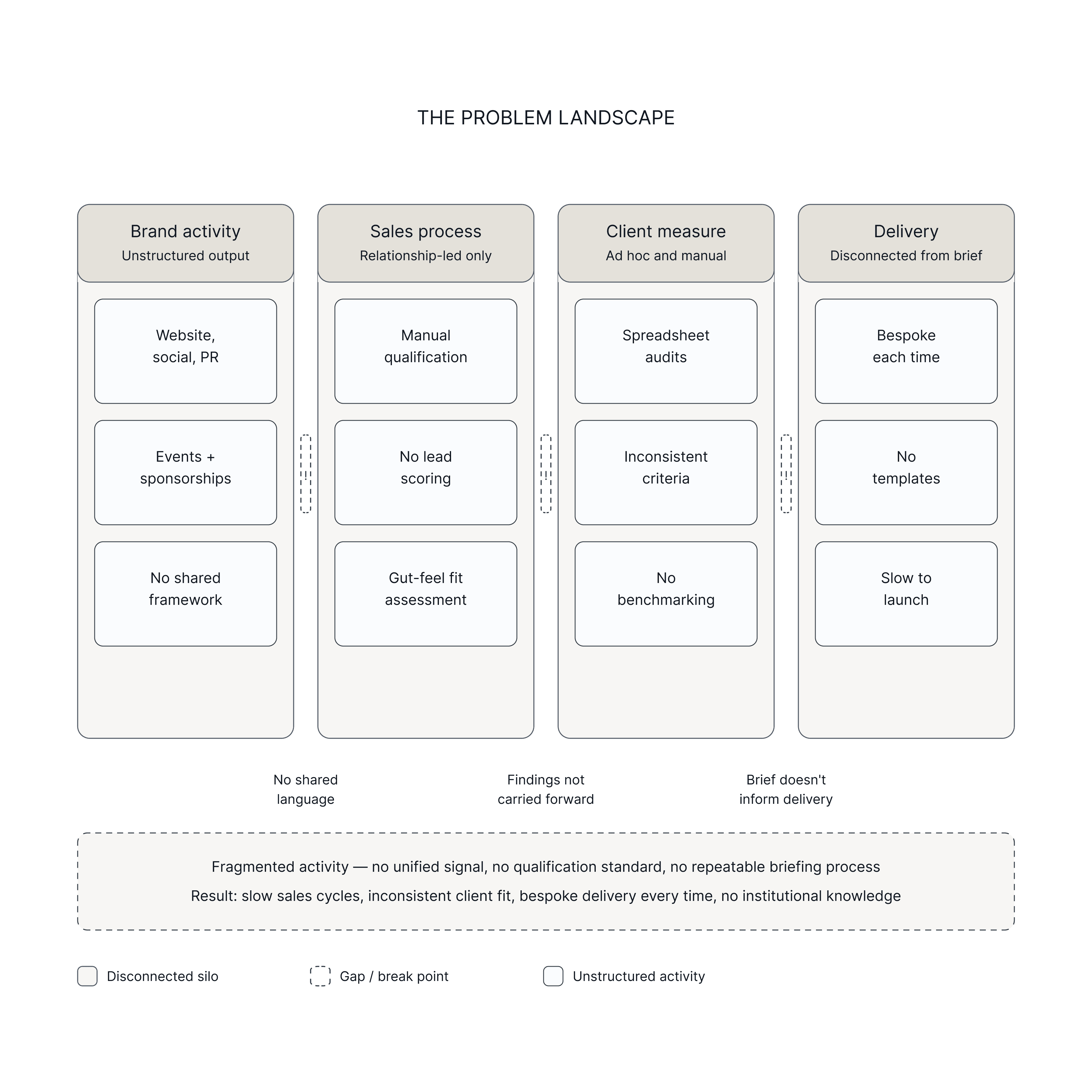
Problem landscape, the starting point
The core challenge was set: How do you translate “consciousness” into something measurable? Antenna helped brands create meaningful impact across sectors in real estate, health, energy, and emerging technologies. But terms like aware, sentient, reflective were abstract, internal language. For users encountering the experience for the first time, these concepts risked feeling vague, and difficult to self-assess against. The assessment would be designed as a standalone experience that would eventually integrate into the broader Antenna website ecosystem. It needed to reduce ambiguity and up engagement.


Designing under constraint.
There was no traditional brief or established precedent. The scope, direction, and rationale evolved in real time alongside a three-week timeline for Climate Week and executive-generated AI wireframes that arrived with a strong point of view already embedded from leadership.
The initial concepts were highly text-heavy and optimized for desktop, creating significant mobile usability concerns. While some adjustments were made, others were difficult to influence given existing stakeholder alignment.
What shipped reflected those constraints. The version shown from this point on represents the recommended direction, the approach consistently supported by the UX rationale throughout the project and refined to reflect what the experience could have become with more time, iteration, and alignment.
Problem landscape, the starting point
The core challenge was set: How do you translate “consciousness” into something measurable? Antenna helped brands create meaningful impact across sectors in real estate, health, energy, and emerging technologies. But terms like aware, sentient, reflective were abstract, internal language. For users encountering the experience for the first time, these concepts risked feeling vague, and difficult to self-assess against. The assessment would be designed as a standalone experience that would eventually integrate into the broader Antenna website ecosystem. It needed to reduce ambiguity and up engagement.


Designing for the off-ramp.
Not everyone completes. The exit intent modal and error state were designed for the user who pauses, hesitates, or tries to leave mid-assessment. Accounting for that behaviour is as important as designing the happy path — arguably more so, because it's where trust is either kept or lost.


Initial report — the Stage 1 payoff.
The final step, score, and report form are the moment everything was building toward. The design's job here is to make the result feel earned and the next step feel obvious, not a sales gate, but a natural continuation.

Outcome
The Compass was less successful as a self-serve diagnostic at scale than it was as a strategic design exercise for the agency. Three outcomes stand out.
User definition and internal vocabulary.
Next work

View project