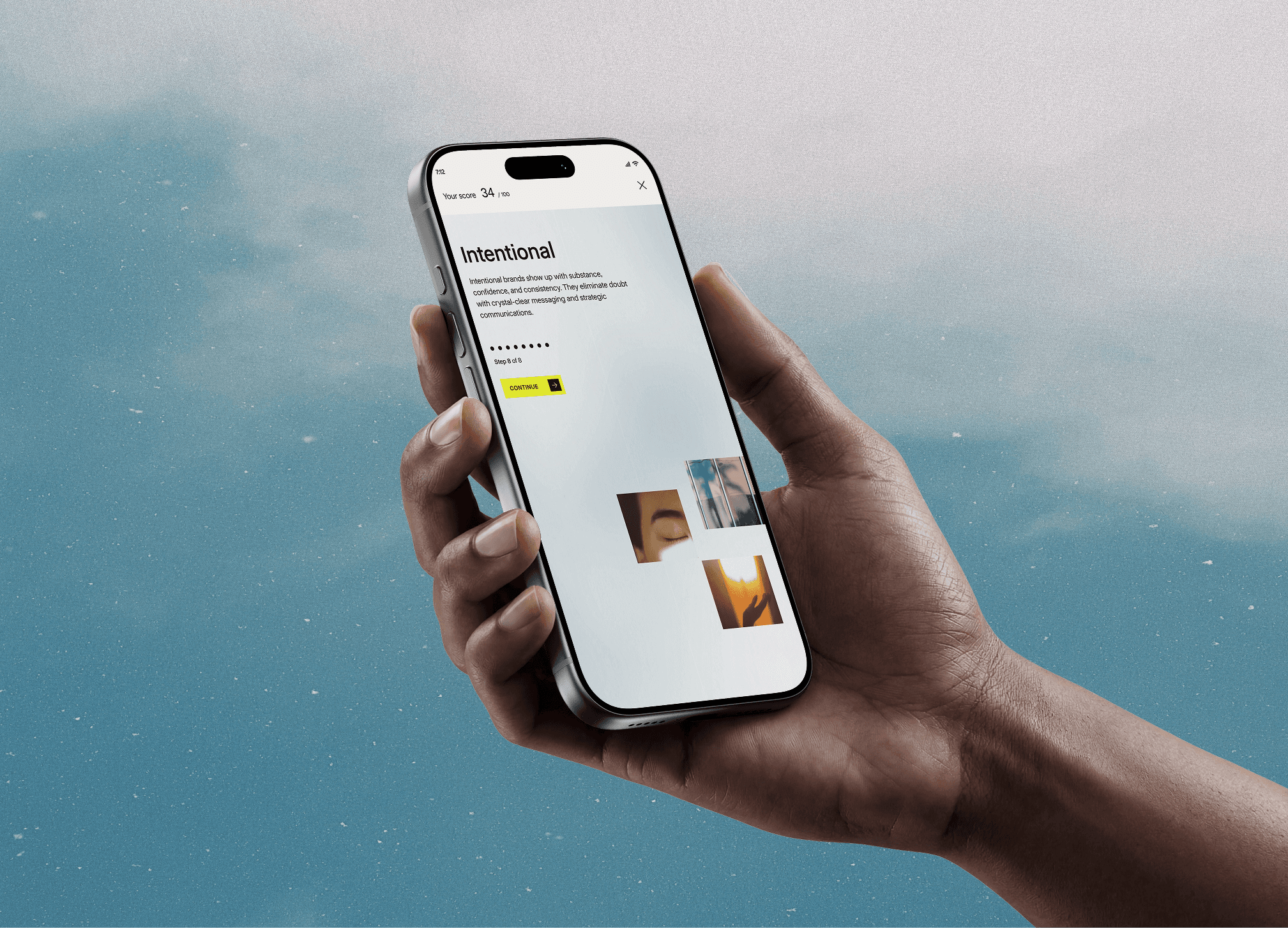
Conscious Compass Assessment Tool
Role and Scope
Conscious Compass emerged from a broader agency rebrand centered on helping organizations move from purpose to measurable impact. As part of that shift, the agency identified an opportunity to create a self-serve assessment tool that could help organizations better understand their current state and uncover opportunities for growth.
The result was Conscious Compass, an AI-powered assessment marketing tool and recommendation platform built around eight dimensions of conscious business. Working closely with a content strategist, practice leads, and executive stakeholders, I helped translate an evolving strategic framework into a cohesive digital experience.
My role spanned experience design, interaction design, systems thinking, and visual direction. I was responsible for enhancing the assessment architecture, designing user flows, defining key interactions, and crafting the design and flow of the reporting experience that transforms user inputs into actionable insights.
The challenge wasn’t simply presenting information. It was translating a complex strategic framework into an experience that felt approachable, engaging, and useful, helping users move from reflection to understanding, and ultimately toward action.
My Contributions
Digital Experience & Interaction Design
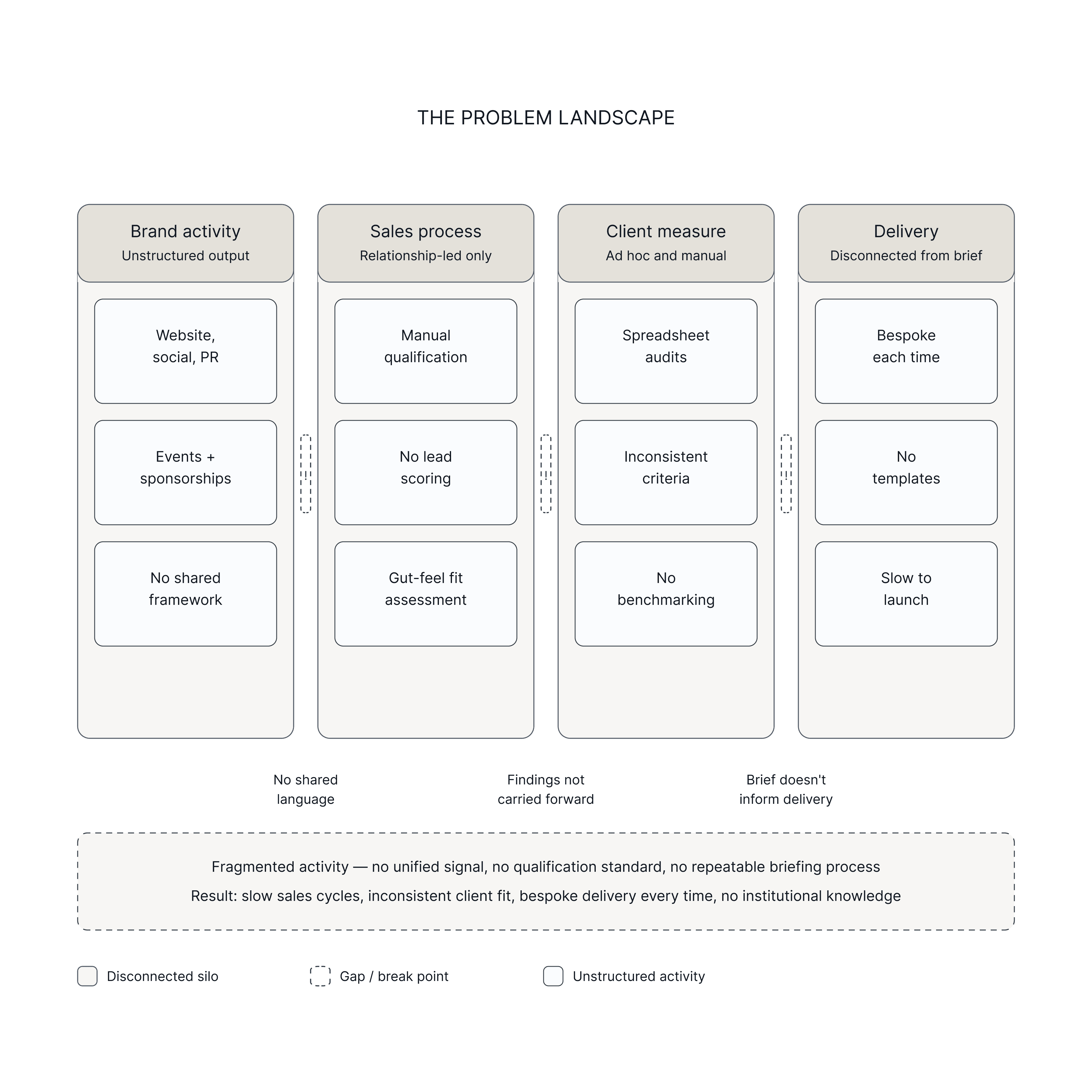
Problem landscape, the starting point
The challenge wasn’t reducing complexity, it was creating enough structure for users to navigate it confidently.
How do you translate “consciousness” into something measurable? Antenna helped brands create meaningful impact across sectors in real estate, health, energy, and emerging technologies. But terms like aware, sentient, reflective were abstract, internal language. For users encountering the experience for the first time, these concepts risked feeling vague, and difficult to self-assess against. The assessment would be designed as a standalone experience that would eventually integrate into the broader Antenna website ecosystem. It needed to reduce ambiguity and up engagement.
Defining a presence through user flow
Throughout the project, I relied on sketches, notes, and lightweight flows to explore how users would move through the assessment experience. As the product evolved, I consolidated those explorations into a formal systems map that made explicit the relationships between assessment inputs, scoring logic, reporting, and AI-powered recommendations.
While these artifacts were created after much of the experience had been designed, it reflects the thinking that guided the work throughout. Mapping the system helped clarify dependencies, reveal opportunities to simplify complexity, and surface key decision points that shaped how users progressed through the experience.


Designing under constraint
There wasn’t a traditional brief or an established precedent to work from. The scope, direction, and overall rationale evolved in real time alongside a three-week timeline leading up to Climate Week and a set of executive-generated AI wireframes that arrived with a fairly defined point of view already embedded within them.
The initial concepts were highly text-driven and designed primarily for desktop use, introducing challenges around readability, hierarchy, and usability on smaller screens. I raised those concerns early and worked to simplify the experience through clearer information architecture, progressive disclosure, and mobile-first considerations. Some of those recommendations were incorporated, while others proved more difficult to influence as broader strategic decisions were already in motion.
What ultimately launched reflected those realities. The version presented in this case study reflects the direction I consistently advocated for throughout the project, a version refined to more fully realize the underlying UX rationale and interaction principles that guided the work from the beginning.
The designs below represent that recommended direction.
Stage 1 in execution, the assessment flow
The assessment experience serves as the foundation of the broader system. Every interaction contributes structured inputs that ultimately inform scoring, reporting, and AI-powered recommendations.
My focus was designing an experience that felt approachable and reflective while collecting meaningful data in a consistent way.
Particular attention was given to pacing, progress visibility, and question design. Because users were evaluating complex organizational behaviors, the experience needed to feel engaging without becoming overwhelming. Clear visual hierarchy, progressive disclosure, and deliberate interaction patterns helped maintain momentum throughout the assessment journey.


Designing for the off-ramp.
Not everyone completes. The exit intent modal and error state were designed for the user who pauses, hesitates, or tries to leave mid-assessment. Accounting for that behaviour is as important as designing the happy path, arguably more so, because it's where trust is either kept or lost.

Initial report, the Stage 1 payoff
Completing the assessment wasn’t the goal, understanding the results was.
The report experience was designed to help users make sense of complex inputs by translating assessment data into a clear picture of organizational strengths, opportunities, and areas for growth.
Rather than presenting scores alone, the experience emphasizes context, interpretation, and actionability. Information is structured to support exploration while maintaining a clear narrative, helping users move from awareness toward meaningful next steps.

Defining a voice through user flow
Color, typography, photography direction, and motif decisions developed for the Compass were carried into Antenna Group's full rebrand. The tool functioned as the design R&D project for the agency's identity refresh. The most lasting contribution sat at the brand level, not the user-flow level.
Color, typography, photography direction, and motif decisions developed for the Compass were carried into Antenna Group's full rebrand. The tool functioned as the design R&D project for the agency's identity refresh. The most lasting contribution sat at the brand level, not the user-flow level. You can view the final product of this rebrand here.
The Compass deployed at CERAWeek and Climate Week NYC as a high-touch engagement vehicle for senior sector leaders. The qualitative feedback in those rooms shaped how the agency framed conscious brand work in subsequent pitches.

Reflection
This wasn’t a typical engagement. It was an internal initiative, which meant it lacked some of the structure and clarity that often comes with a client relationship. At the same time, the work was moving into product and AI territory that felt genuinely new, not just for me, but for the organization building it. There wasn’t a clear precedent to follow or a fully defined brief to anchor against. Some of that was freeing, and some of it introduced a level of ambiguity that was difficult to navigate.
One of the biggest lessons came from the timing of the systems-thinking work. The effort to map the broader problem space and system architecture happened later in the process, largely as a way to validate decisions that had already been made and clarify where the product needed to go next. In hindsight, I would approach that differently. A deeper understanding of the system earlier fundamentally changes the quality of the decisions that follow. Experiencing both the benefits of that clarity and the cost of arriving at it later has changed how I think about approaching future projects.
Creatively, the project challenged me in a different way than most design work. The system relied on maintaining consistency across eight attributes without letting the experience feel repetitive or mechanical. That required a level of restraint and trust in the structure itself, allowing content, interactions, and information hierarchy to carry more of the experience rather than relying on constant visual variation. It shifted how I think about designing systems that need to scale while still feeling engaging and human.
What started as a marketing initiative gradually evolved into something much closer to a product experience, and that transition happened in real time without a clean handoff or redefined brief. Navigating that ambiguity while still creating something coherent, useful, and scalable is one of the aspects of the project I’m most proud of. Just as important was the opportunity to step back afterward, reflect on the process honestly, and identify how I would approach similar challenges differently in the future.
Next work
